
Possible Love
Written by Andreas Babiolakis
Warning: This review is for Possible Love, which is a film presented at the 2026 Toronto International Film Festival. There may be slight spoilers present. Reader discretion is advised.
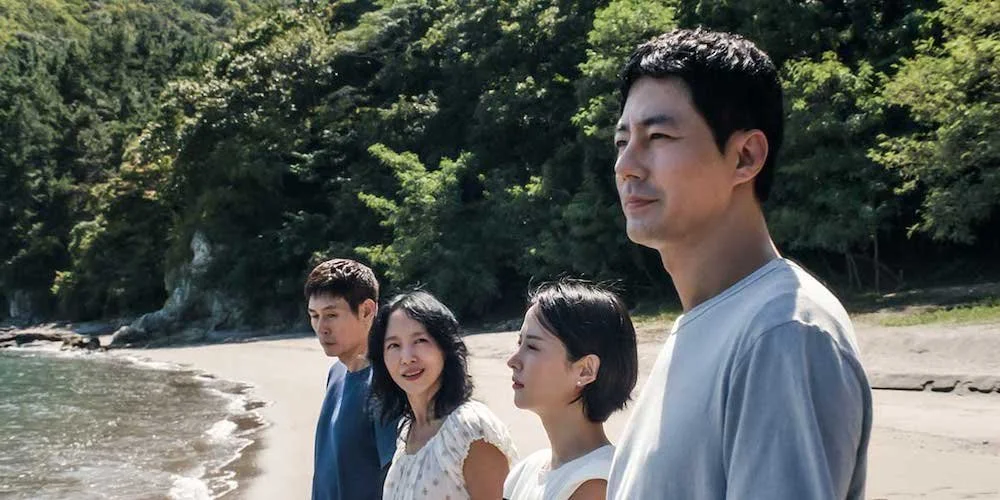
Image courtesy of the Toronto International film Festival.



In the over thirty years of his career, Korean auteur Lee Chang-dong has only released seven feature films. It just took eight years from his sixth, the beloved Burning, to finally reach his latest, Possible Love. For those of you who are only familiar with Burning, you may be expecting another slow, intense thriller, but Lee's career offers far more than just one style; if anything, Burning is a bit of an anomaly for him. Possible Love furthers his ability to take on many styles and tones with some of his warmest writing and direction to date, but that doesn't mean that it is naive either. How could it be when Lee has accurately tapped into the minds and hearts of people for decades? He understands how people think and feel better than we do, and it has been one of his strengths for the majority of his career. With Possible Love, he acknowledges the feigned, marketable idea of what a healthy relationship should look like, as well as the likely reality: marriages can be rocky, and the love within them may not be apparent.
Possible Love's small cast is a bit of a who's who of contemporary Korean acting royalty. There's lead Jeon Do-yeon (The Harmonium in My Memory, and Lee's Secret Sunshine) as Mi-ok, and Sul Kyung-gu (a frequent collaborator of Lee's in Peppermint Candy and Oasis) as her husband, Ho-seok. Ho-seok has just been laid off and both he and his wife worry about the road ahead (which includes the wellbeing of their house and their son). Mi-ok comes across a documentary filmmaker, Ye-ji (Cho Yeo-jeong, of Parasite fame). Her husband, Sang-woo (Zo In-sung, known for works like The King and Escape from Mogadishu), is a wealthy producer. This elite couple can generate their own fortune, comfort, and dream jobs. Do-yeon and Mi-ok, on the other hand, are taking their position minute by minute. Nothing seems to be in their control. Not even the air they breathe feels infinite: how soon does that last breath come when anxiety leaves us gasping?
As stated, Mi-ok and Ye-ji cross paths. Mi-ok looks like a great subject for a project that Ye-ji is working on: a documentary about the impacts of loved ones being laid off. They connect time and time again, and Lee's patient direction makes this budding friendship feel far more organic than forced. Let's be honest, a film about different class systems is inherently organized so that characters and their viewpoints do not align. Lee tiptoes forward to ensure us that the coast is clear: these are two people of different walks of life who can co-exist (and quite smoothly at that). Once this friendship blossoms, Possible Love goes further. Let's now introduce the husbands. One is on top of the world, with good looks, excessive amounts of money, and everything and anything he has ever wanted. The other is traumatized, alcoholic, and afraid to open up. Sure, there is a documentary being made and he doesn't open up for it, but Ho-seok doesn't open up to us, the audience, either. He is a man of mystery, but that intrigue is one of dread, not curiosity. What is behind those faded, broken eyes?
Nonetheless, Mi-ok and Ye-ji keep bonding, and now their connection goes far beyond that of the documentary at hand. A major act of the film takes place in the summer home of our wealthy family, and Mi-ok and Ho-seok are invited to spend some time with them recreationally. This is where most of the film's blatant magic comes from, and so I will refrain from going much further outside of bringing up one major success: this is when the truest nature of every character comes out (either as catharsis, desire, or self-sabotage). At this point, you will learn that everyone's concept of being on the "same page" is different from the other three participants, and that the entire film that preceded this act reads entirely differently now. I was sure that I liked Possible Love up to this moment, but it was this act that truly sold the film to me. Of course, it's easy for directors to declare that people of various upbringings and circumstances will think differently, but it's both the common ground and the unique ways that we are unique (and not the same beaten and dead horses shown time and time again) that got to me. Again, if anyone is great at understanding exactly how humans operate, it's Lee.
While this pivotal act is magnificent, I do love what came before it, particularly what Lee is saying about the honesty and integrity of filmmaking. I love that he focuses on documentaries as opposed to fictional motion pictures, since there is an implication that the former are truthful. Even with the intention of telling the complete story, documentaries are cut-up, assembled, and presented to the point of at least partially obscuring the truth. We can see that with highly biased documentaries that exist, or we can see enough in Lee's inner-cinematic study. In that same breath, he turns the camera on himself as both the capturer and the captive. Is Lee able to display an entirely honest look at the sociopolitical divide of South Koreans (and citizens of the world) in this film? By admitting that he cannot, he has done a better job than most. He also looks at himself as being a part of the conversation. Can a filmmaker realistically see eye-to-eye with the masses who have never experienced their privileges and lifestyles? This answer is a different one. I would say "yes," so long as they are not blinded by their fortune.
Lee is a realist first and foremost, so his findings are endearing and moving, not aggravating like the tone-deaf blatherings of out-of-touch auteurs. Cinema is an intrinsically skewed medium — one that is completely contingent with the views of its director. By admitting this in Possible Love, it is even easier to accept Lee's picture as one of the people of the world (and not the delusions of an upper-class person's depictions of society that we usually get). Even so, no matter who you are, the moon is the exact same one and it glows above us all; Lee ensures to send us off on this gorgeous image, where we — the people — will funnel out of the cinema to our individual lives. Within these four walls, we were all equaled. During Possible Love, we were all being spoken to, whether we were at TIFF as a high-level producer, someone with connections, or a member of the public who managed to beat the box office after many efforts. No matter the angle, we were all seen and heard. That is how film unites us. Possible Love will keep us going for another ten years until Lee returns once more.


Andreas Babiolakis has a Masters degree in Film and Photography Preservation and Collections Management from Toronto Metropolitan University, as well as a Bachelors degree in Cinema Studies from York University. His favourite times of year are the Criterion Collection flash sales and the annual Toronto International Film Festival.