
My Wife Cries
Written by Andreas Babiolakis
Warning: This review is for My Wife Cries, which is a film presented at the 2026 Toronto International Film Festival. There may be slight spoilers present. Reader discretion is advised.
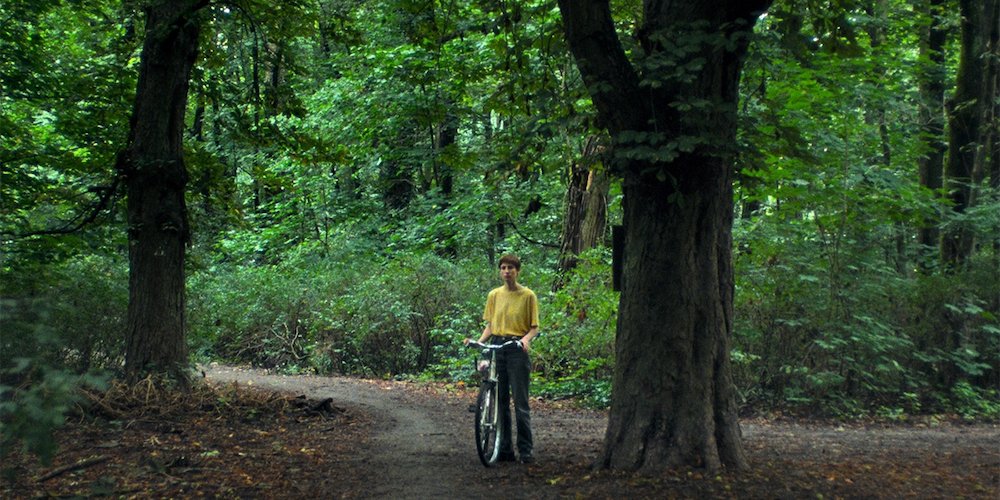
Image courtesy of the Toronto International film Festival.


I think slow cinema can be done very well. If you look at the films of Apichatpong Weerasethakul, you'll see motion pictures slowed down to a meditative crawl that encourages you to not just reflect on what you are seeing but take note of how you are feeling. Laz Diaz turns film into a cinematic vestibule for viewers to be surrounded by, as if these flickering flames are simply the existence of life around us. I could keep going with example after example (Bela Tarr, Tsai Ming-liang, Bi Gan, et cetera), but you get the point. I am no stranger to films that have long, unwavering shots that force you to ruminate on what you are seeing. However, a film must need a reason to be slow in the same reason that it can't just be arbitrarily fast (like a parade of fast cuts just for the hell of it). This brings us to Angela Schanelec's My Wife Cries — an example of 2026 slow cinema (and it's only an hour-and-a-half at that). Part of the Wavelengths program at the Toronto International Film Festival, My Wife Cries' inclusion feels fitting given the namesake of the program (Michael Snow's iconic experimental film, Wavelength, which features a fixed camera focusing on a single shot and slowly adjusting its zoom over the course of forty-five minutes).
My Wife Cries at first appears to be a direct offshoot of Snow's film (which isn't a prerequisite for the Wavelengths program — it's just a loose term for a variety of avant-garde and experimental films that TIFF showcases each year). We kick off with a lengthy shot of an office near a construction site, and the subdued rattling of the workers nearby creates an oddly comforting ambience. The walls are painted off-white, so they almost take on any colour that is vibrant enough near them. Given the kind of program that My Wife Cries was a part of, I was fully prepared to never leave this room, listening to the office women taking calls, chattering amongst themselves, and whatever else came the way of this small, enclosed area. A crane operator enters the room and patiently waits; I thought this was preparing us to do the same. However, that shortly changes as we cut to the rest of the story — it winds up being that of the crane operator. His wife has just been in an accident and is physically fine for the most part; it was the other person who passed away (someone she was having an emotional affair with). She weeps because of grief, shock, and guilt.
Schanelec's use of glacial pacing makes the empty spaces in these initial revelations feel intentionally agonizing; sometimes, there aren't enough words that can express the weight of a circulstance. For the majority of the rest of the film, My Wife Cries shows how life goes on after tragedy, but it never forgets to at least hint at the marriage that is lagging behind the speed of existence. The dullness stems not from the experience of being alive, but, rather, what life is like tethered to someone else who also feels stalled (and their flame dimmed). You can say that the film excels at extracting the spark of idiosyncratic experiences (like a collective round of interpretive dance, an unexpected orchestral rehearsal in the middle of a park [and the rain that causes them to disperse], or the food that enriches our day (My Wife Cries has some of the most succulent looking redcurrant, featured in a divine close up). On the note of the last point, Schanelec shows what it looks like when you are rejuvenated — like a long shot of vegetables on a cutting board (whose skin and shadows almost seem to paint the empty spaces surrounding them — My Wife Cries implements a slight and careful use of filmic colour bleeding to achieve this).
However, I also believe that My Wife Cries gets lost in its own headspace (even though it is essentially inviting us to do the same). When certain scenes are prolonged, it almost feels like this is a must to keep the film from ever waking up and jolting us into something unexpectedly upbeat. This prevents moments from ever hitting as hard as they should, like a climactic scene involving a severe lack of sexual intimacy (although the effort is there); of course the deadness is intentional, but you are also meant to feel the pain of such a sequence, not just the stillness. In the way that the early scene with the titular wife crying feels like you are spying on the worst moment of this pair's existence (and this is handled by the emptiness of the scene, not the action), I expected that these latter moments would also sting. I guess you could say that I have mentally moved on, and there is art in that (given the film's subject matter), but I would argue that you should still feel. If the film is arguing not just that life is effectively dead if we are living a lie (and that there is much beauty when all is well), we need more of the sentiment of the latter as well. I will say that I was expecting to just sit in that office for the entire film, and — while we are constantly being transported — I would argue that we, mentally, never left that endless act of waiting; what is the difference between the chore of waiting for your turn and, as My Wife Cries paints it, everything else in life? I suppose that really makes you think, and at least some of Schanelec's mission is accomplished. I just wish that there was some additional yang to this yin.


Andreas Babiolakis has a Masters degree in Film and Photography Preservation and Collections Management from Toronto Metropolitan University, as well as a Bachelors degree in Cinema Studies from York University. His favourite times of year are the Criterion Collection flash sales and the annual Toronto International Film Festival.