
The Liberation
Written by Andreas Babiolakis
Warning: This review is for The Liberation, which is a film presented at the 2026 Toronto International Film Festival. There may be slight spoilers present. Reader discretion is advised.
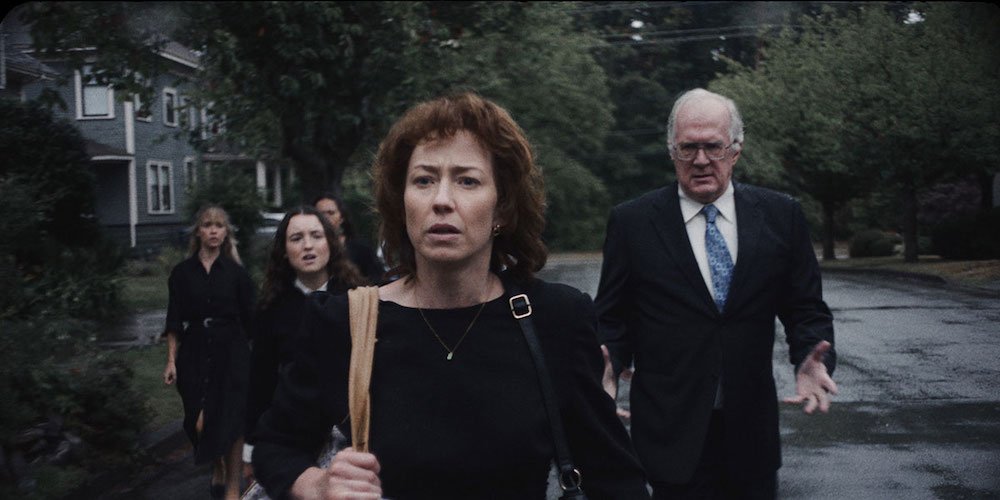
Image courtesy of the Toronto International film Festival.


The context of a film greatly matters. It's one thing to judge a film based on how you receive it, but it's another to understand the intentions in which it was delivered to you. Case in point: Guy Nattiv's The Liberation. This was a film that originally greatly frustrated me because of its potential and the amount of coincidences, abandoned ideas, and paradoxes arose while watching it. Following a Holocaust survivor who winds up entwined in a cult, The Liberation poses this idea of psychological vulnerability and what it looks like when a broken person is taken advantage of. However, because of all of the aforementioned concerns, it was something I didn't fully buy into, and I once blamed Nattiv and Noa Berman-Herzberg for not completing their blueprints (I will go into those concerns later). It was by the final title card and shot that everything changed for me: it is revealed that The Liberation was not only based on a true story, but it is loosely inspired by the story of Nattiv's own grandmother. Suddenly, the hints of laziness now look like the blood, sweat, and tears that went into making sense of a mystery — Nattiv and company working with what they have to try and solve what happened. Them not fully knowing alongside the audience makes a bit more sense now. While enough of the story is still fictional, enough of it is based on reality that I cannot be too harsh on the film's findings. What once appeared to be a half-baked story is now a memento to a lost cause that not even the magic of the movies can solve. The Liberation comes off as a lot more sincere and meaningful now; even though the film ended with this information, I think it's best to kick off this review with it so you do not face the same unnecessary vexation that I did. However, this doesn't absolve the film of all of its flaws: just the most damning.
The primary reason to watch is for star Carrie Coon, who plays Rita Cooper (the survivor and cult member in question). Coon remains one of the most unsung stars of the twenty-first century — she is someone who deserved a thousand Emmys for The Leftovers alone, never mind all of her successes before and after. Rita's story is told via two ongoing timelines: before she joined the Harmonia cult and after. Before, she worked in a bank and got by day-by-day. She was married to Reuben (played by Coon's real life husband, Tracy Letts, which adds an extra layer of sadness when you see how her family falls apart) and has two children: no-nonsense Ella (Bella Ramsey) and "wherever the wind takes me" Jo (Odessa Young). Rita is forever stricken by grief and trauma after her experience in the Holocaust when she watched and heard loved ones die. One day, she is approached by a seemingly innocent younger woman, Ricki (Lily James), who invites her out to a hangout with some of her friends — this is a highly suspicious invite, and one that makes no sense for scrupulous Rita to accept, even with the film's blanket explanation (that she wants to have a freer, happier life) — then again, it could be the best that Nattiv and company could come up with (we will never know why his grandmother went along that first day).
The other timeline involves daughters Ella and Jo trying to work their way to their mother, who now lives on the Harmonia commune. It's not as simple as dropping by and visiting her — they have to ingratiate themselves with the community. Ella is driven by rage and is not susceptible to the cult's whimsy or tactics. Jo, on the other hand, is her mother's daughter. It's never explained why Jo fell victim to the Harmonia way, since it's implied that most of the recruits are damaged in some way (maybe the simple answer is that Jo was scarred when her mother left their family, but the film still never really sells this idea; it instead treats Jo as someone who just blindly accepts whatever comes her way and naively begins to believe the ways of Harmonia, which is far less interesting). Meanwhile, Rita is not the same person anymore. She is an overly optimistic practitioner of earthly rituals and practices who now feels thrilled to be alive. Even if this character is a bit underwritten, it is Coon who makes her impossibly believable.
However, what also has to be coherent is the leader of this cult — so we can understand how someone would join. Ricki makes no sense, and I do not blame Lily James for this problem, but, rather, how Ricki is written. This is a cult leader who is made to be alluring in a sexy way (even though the vast majority of Harmonia is not in love with her, outside of Rita). There is very little else that The Liberation gives her that actually reads as convincingly manipulative or magnetic. If you watch The Master, you will both understand how ridiculous The Cause is and how its members could not resist or deny leader Lancaster Dodd. Sure, you could chalk this up to Philip Seymour Hoffman's generational performance, but I also think that he was given far more to work with outside of "Ricki is mesmerizing just because she can be." Not once did I catch myself off guard liking what Ricki had to say or how she said it (like I have with the great cult-leader performances of years past). I never fully understood what Harmonia stood for outside of it being an all-female community that believed in self-cleansing, natural methods provided by the Earth, and abandoning whatever was deemed a vice (including traditional medical practices like using insulin if you are diabetic). These are all the trademarks of a traditional cult: what makes Harmonia stand out to the possible — and likely — naysaying, and how were women deceived into joining?
The film is rife with many such questions. Who were the two men with the pickup truck who seemingly work with Harmonia, and why are they the only two men to affiliate with this cult (when it is made known that it is for women only)? What are the odds that Ricki would appear right there and then during a heated climactic moment (of which I won't spoil) — there is a chance that Rita called for her, but the way it is laid out in the sequence just seems highly convenient as opposed to logical (keep in mind that the film also takes place in the eighties). Why isn't the informant subplot more of a prominent thread, and how could they not have had anything to nab Ricki with years before just cause is finally found (again, without spoiling)? Too much of the film is reliant on you just believing everything it tells you when it should be doing the absolute opposite: showing you why and how this was believable to those involved.
Coon's dual performance will keep you going through the majority of the film's wobbliness, and it all leads to a third act that no longer begs you to suspend disbelief and instead asks you to feel (and feel you will). The harrowing final third of The Liberation places Rita in the worst crossroads of her life: does she choose her children, or Harmonia? After abandoning her family, she is now in the position of maybe having to give up Harmonia as well. Things are not so simple, and what I am omitting from this review are key variables that make Rita's dilemma even more difficult for her. Even though I never understood how Harmonia could work on people, it is Coon's brilliant acting that made me know that Harmonia was real for her, and this choice is one that could shatter her spirit. How could she go back to a neighbourhood and family she deserted? How can she face her deeply buried trauma again without Harmonia? She was meant to belong somewhere at multiple points in her life, and she now feels as though she belongs nowhere. Harmonia didn't heal her like she thought: she is now more broken than ever. Even if much is left unsolved or unanswered (the storyline with the daughters, what happens after "the end," without spoiling once again), all we know is how much this affected Nattiv's grandmother, and much of that is thanks to Coon's breathtaking performance — worth the price of admission alone. If The Liberation was filmed to honour a loved one who went through hell and back, it is Coon who solidifies the power and value of this tribute.


Andreas Babiolakis has a Masters degree in Film and Photography Preservation and Collections Management from Toronto Metropolitan University, as well as a Bachelors degree in Cinema Studies from York University. His favourite times of year are the Criterion Collection flash sales and the annual Toronto International Film Festival.