
Hedda
Written by Andreas Babiolakis
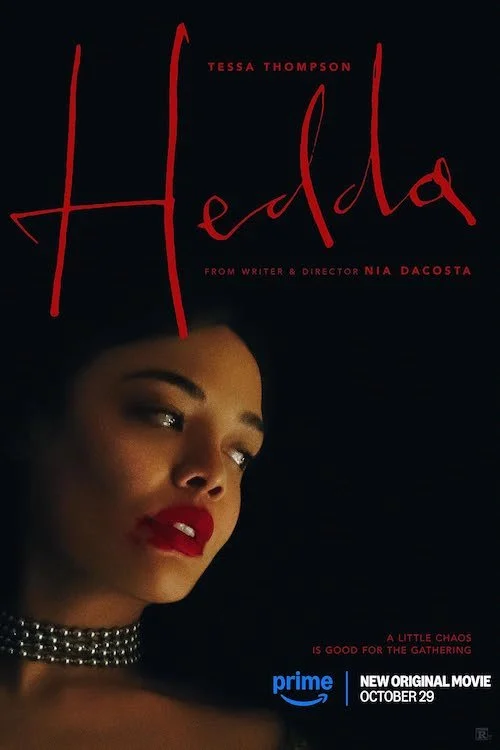


Nia DaCosta's version of Henrik Ibsen's masterpiece, Hedda Gabler, strives to achieve the majesty of such a text while not quite coming close enough. DaCosta's Hedda (reducing the character's name to just one word, rendering her a megastar like Prince, Sade, or Madonna) has all of the markings of a prestige film, but that simply isn't enough to actually be one. However, I do applaud DaCosta and company for their efforts to adapt this beloved story in a new way, placing Ibsen's work in 1950s England (it isn't overly modernized, at least). Hedda is played by Tessa Thompson, one of my favourite actors working today. While Thompson gives this performance everything she has and then some, I don't quite feel her resonate in the same way she has before in many other roles (even minor ones). I feel like the film's overall objective to please its audiences softens many of its blows (including, ultimately, Thompson's performance: its biggest mistake). The story of Hedda Gabler is not a pleasant or serviceable one; why does DaCosta frame it with safeness?
During Hedda's party at her mansion, a lot goes on: revelations of character, unexpected intimacy, and even a death. We begin the fin with Hedda being interrogated by the police, and so we go back to the source of this crime. With that in mind, DaCosta's "ambiguous" ending makes little sense; is it truly an open ending if we know what transpires? As the evening goes on, we get a character study of Hedda and her party's guests (including, and especially, Eileen Lovborg, played by Nina Hoss); I feel like DaCosta was so transfixed on making Hedda a film about deconstructing Hedda Gabler as a character that it loses sight of how to convey a story properly. Much of the film becomes "who cares what takes place" because we are much more invested in who is a part of these events (but not the events themselves). This might make for an interesting study after watching a stronger version of Hedda Gabler, but to serve as a stand-alone take on Hedda Gabler? It does not.

Hedda has all of the markings of a prestigious film but it instead feels safe and hollow.
What carries Hedda a bit is how expertly produced it is, from its intricate sets to the jaw-dropping costumes and hairstyles. This does feel like a party, and DaCosta at least makes you feel as though you are a part of it (and the high life, for a little while). It does wear thin when you feel like you are treading water in the same place and without venturing towards other parts of the sea; is the same view as pleasant when you over experience it without anything refreshing to see? Considering that most of the film takes place on the same premises, how rich it feels only takes us so far; this is especially true when Hedda resorts to pulling most of its punches. This is, yet again, one of the many films you can see but not quite feel despite how frequently it begs to be felt; at a generous hour-and-fifty-minute runtime, it at least doesn't overstay its welcome (although it comes quite close).


Andreas Babiolakis has a Masters degree in Film and Photography Preservation and Collections Management from Toronto Metropolitan University, as well as a Bachelors degree in Cinema Studies from York University. His favourite times of year are the Criterion Collection flash sales and the annual Toronto International Film Festival.