
The Housemaid
Written by Andreas Babiolakis


Warning: This review contains spoilers for The Housemaid, as well as the themes of domestic abuse. Reader discretion is advised.
By the time I was finished watching the ever-so-popular thriller, The Housemaid, I was gobsmacked: the Paul Feig of Freaks and Geeks, Bridemaids, and Spy fame made this film? I know he directed A Simple Favor, which is at least cut from the same cloth as this film, but The Housemaid felt straight-up like something a director of Twilight or Fifty Shades of Grey would make; this isn't typically a film made by someone who usually has a firmer grasp on the craft than this showcases. Based on the adored novel of the same name by Freida McFadden, I think The Housemaid would have done extremely well at the box office if it was directed by an impaired pangolin, but at least Feig is a big-enough name that the film could have had some sort of life within it; because of his experience — and one other major element (more on that shortly), The Housemaid is actually a decent watch. Otherwise, it's melodramatic tonally and underperformed on the surface: a strange whirlpool of too-much and not-enough.
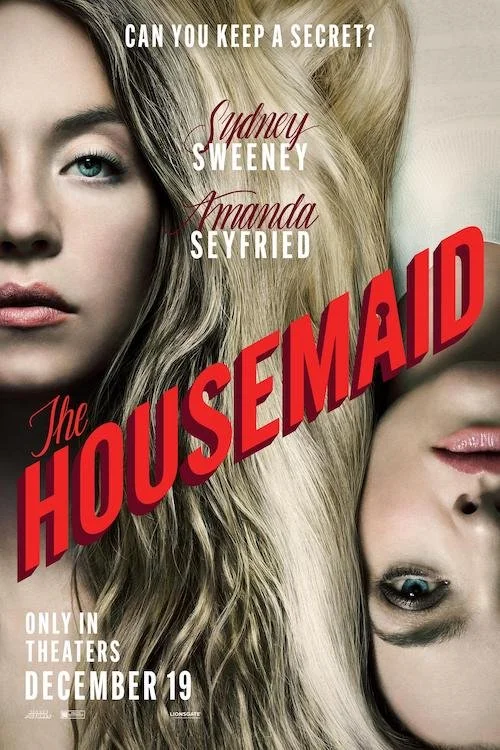
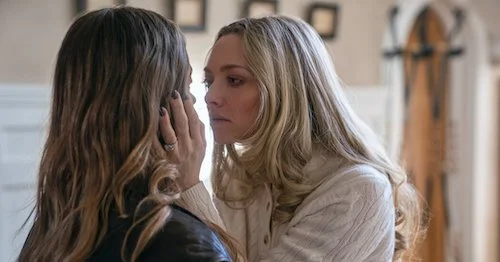
Millie (Sydney Sweeney) is seconds away from violating parole and is in dire needs of both a job and a place to stay (after serving years in prison, she now lives in her car and is struggling to get by). She interviews to be a live-in housemaid for Nina Winchester (Amanda Seyfried) and her husband Andrew (Brandon Sklenar). Surprising to her, Millie gets hired and can begin immediately. Millie is to live in the guest room up in the attic and tend to every need that the Winchester family has (including daughter Cecelia, who is Nina's biologically, and Andrew acts as her stepfather). It doesn't take long for Nina to remove her pleasant demeanour and start being aggressive towards Millie in highly abusive ways (from gaslighting her to throwing tantrums and firing her repeatedly). However, in the way that Millie had a loaded motive for her hiring, so does Nina, we learn: all is not what it seems. By the second act, when Millie and Andrew get close to the point of no return (The Housemaid gets a little silly with its sexual fantasies here), we learn that Nina isn't the antagonist: Andrew is.
The first third of The Housemaid can be chalked up to mediocre acting by most, and what can only be described as a blend of Hallmarky and pornographic dialogue and scenarios; I get that this film is meant to be a bit of a romanticized depiction of mystery and thrills, but its writing comes off as significantly premature compared to how this film looks. Half the reason why the acting is so stunted is because of the clunky dialogue, of which only Seyfried is able to overcome the robotic phrases and expressions printed on paper (Seyfried is terrific in this role, but I cannot say the same for literally anyone else in this film). Once the narrative twists take place, The Housemaid becomes far more interesting (they keep coming for two entire thirds of the film as well, so at least there is much to look forward to, but it takes an undercooked slog of an opening act to get there). Having said that, why should we be rewarded for making it through a so-so setup that is bogged down with flaws? Considering that this is a film with mystery throughout it, should we not be compelled by a strong start?
The Housemaid aims to be the next best twisty thriller. It is instead the idea of such a film.
Even with these mainly well-handled twists (there are many a handful of plot holes I could think of, more on those shortly), The Housemaid doesn't go far enough with what it has to offer. So, it turns out Andrew is psychologically manipulative to the point of being extremely abusive. Nina was an earlier victim of his who strategized Millie's hiring as a method of escape for Cecelia and herself. Sklenar's performance of Andrew may place you under his spell, but he never accurately hits the notes necessary to make him believably threatening or scary; he comes off more as angsty or irksome (and, honestly, who would be coerced to stay with someone when they are as effective as a mosquito who won't stop biting you?). We also have Sweeney's Millie who is okay at times but not nearly gritty enough to evoke the harrowing turns of the final act or even the believability that this very woman is homeless and has lived a difficult life. My wife correctly pointed out this brutal miscast, and when she elected someone like Florence Pugh to play Millie (she has read the novel while I haven't), I could not see past how poorly Sweeney fits (or doesn't) here. It was at that moment that I realized that — outside of some gory images (the slicing of one's stomach, the pulling of a tooth via pliers) — The Housemaid didn't possess any serious grit or grime; is that not the point of a thriller that is supposedly unafraid to get its hands dirty?
The only person who leaves it all out there in a film that is all about multiple personalities and hidden natures is Seyfried, who clenches her jaw, bulges her eyes, and truly commits to the brutality of such a story. Otherwise, The Housemaid is more like the idea of a great cinematic thriller as opposed to actually being one. For instance, it gets so carried away with trying to pull off more twists than it needs to that it leaves traces of mistakes at its own crime scenes (how did Nina have a cheque for Millie at the funeral when she didn't expect to see her there, for instance; if Nina's meanness towards Millie is a means of warning her of Andrew's true nature and preparing her, some of her outbursts don't add up once you learn the first major twist; I could keep going but won’t). A film like The Housemaid is indicative of a film that wants to astound audiences as opposed to one that simply does. I will admit that The Housemaid gets a bit fun when it hits the ground running, but a lot of that excitement ends when you go back and start trying to deduce the actuality of the film's events with a new perspective; what good is a mystery thriller that doesn't last long in the confines of your mind and your booming spirit as a cinephile? A film like this that was made to be in the moment is precisely what is wrong with it, from casting trendy names to evoking cliched sentiments (however, I do approve of the use of my all-time favourite Lana Del Rey song, "Cinnamon Girl"). Nothing that is based on temporary means and ideas can ever be truly impactful and everlasting.


Andreas Babiolakis has a Masters degree in Film and Photography Preservation and Collections Management from Toronto Metropolitan University, as well as a Bachelors degree in Cinema Studies from York University. His favourite times of year are the Criterion Collection flash sales and the annual Toronto International Film Festival.