
Filmography Worship: Ranking Every Sergei Eisenstein Film
Written by Andreas Babiolakis
Filmography Worship is a series where we review every single feature of filmmakers that have made our Wall of Directors

One of the most important figures in all of cinema is Soviet filmmaker and theorist Sergei Eisenstein, who is likely a very familiar name to you if you ever attended any form of film school (if not, I hope this list functions as a lesson of sorts). A master of cinematic montages — the art of comparative or contrasting images being spliced together to convey a different mood, message, or sentiment — Eisenstein not only changed how films could be edited, his avant-garde techniques pushed directors towards new artistic means for representing themselves cinematically. Inspired by Kabuki theatre, Eisenstein was able to replicate the striking visual splendour of the Japanese artform with his extreme close-ups and emotionally driven compositions that were not a staple of motion pictures quite just yet. Of course, that was not his only ideological affiliation, as one cannot mention Eisenstein without bringing up his Bolshevik connection and his support of Vladimir Lenin’s Red Army during the Russian Civil War (to the point of even joining said army). Yes, as much as Eisenstein was a cinematic revolutionary, he was a propagandist as well.
With that in mind, Eisenstein’s political allegiances were still not so cut-and-dry. Politician Joseph Stalin tried to connect with Eisenstein on numerous occasions, including the final project, Ivan the Terrible. What was meant to be a three-part filmic series wound up being incomplete; the second part was outright banned by Stalin’s government when it was deemed ineffective as propaganda (considering how the notorious tsar was shown as being a complicated leader full of dilemmas and weaknesses, as opposed to a pristine, fearless dynamo); the third part ceased to exist almost entirely as a result. Eisenstein wanting to work in Hollywood once offers were made to him, which greatly impacted his affiliation with the USSR (additionally, Hollywood didn’t work out for him either). Even outside of his filmmaking, he clearly played by his own rules: trying to only honour himself and what he believed in, as opposed to what he was told to believe in. He remains a bit of a difficult subject as a result: there is a dark side to his projects because of the reasons why a number of them existed, but their technical and artistic magnificence cannot be denied, nor their influence on all things cinematic.
Eisenstein didn’t have many projects by the end of his life, dying at the young age of fifty after suffering from two different heart attack episodes. What remains are a handful of film school staples, some celebrated examples of world cinema from the early days of filmmaking (spanning from the silent era up to the forties), and a few underrated cuts to boot. Additionally, I will be including unfinished works that — by Eisenstein’s hand — are breathtaking even in their incomplete states (I will not be including Ivan the Terrible Part III because judging a film on a couple of snippets [that may or may not actually be from this film, as opposed to cut footage from the other two parts] just doesn’t make sense). I also won’t include The Storming of La Sarraz, which is lost. Otherwise, this near-dozen collection of films paints a big picture of an intriguing, seminal director whose greatest achievements still blow cinephiles away. Here are the films of Sergei Eisenstein ranked from worst to best.

11. Glumov's Diary
Eisenstein’s debut film is a five minute short film; appropriately, the director is seen in the very first shot, as if to introduce the vignettes of a theatrical nature that are to ensure (in actuality, it seems more fitting that he is introducing himself before we get familiar with him via his entire career). The premise is simple: Glumov’s diary has been stolen and needs to be retrieved. Gunning through a series of images and scenarios in pursuit of the ultimate prize, Glumov’s Diary is a silly short film by a filmmaker whose remainder of his filmography was far more serious. I cannot say much about this short outside of it being fine and in-your-face, but it is a bit of an interesting trinket for those who wanted to see how Eisenstein began his career; his following film would prove to be far more influential and championed.

10. Bezhin Meadow
Commissioned by a communist youth group, Eisenstein’s Bezhin Meadow was halted before completion for censorship related reasons. The film exists in fragmented form, mainly still images that can almost act as a storyboard for what promised to be an extravagant epic. I must rank this film close to the bottom of this list because it is barely a film at all, yet the imagery is so strong that I cannot help but wonder what Bezhin Meadow could have been (you know, minus the staunch propagandistic affiliations). Major fans of Eisenstein’s creativity and aesthetic owe it to themselves to seek out the half-hour that remains because even these dregs exhibit the Soviet auteur’s knack for filmmaking.

9. El Desastre en Oaxaca
While working in Mexico on ¡Que viva México!, Eisenstein took note of the massive earthquake that shook and destroyed much of Oaxaca. Eisenstein visited Oaxaca to document what transpired in a way that recognizes the ruination of the 1931 disaster while using the art of Soviet montage to convey this information via a fluid stream of delivery. The film is only ten minutes long, but it feels like a look at the human side of Eisenstein who was frequently using film to showcase his talents and vision; here, he is merely a human being who couldn’t help but connect with this tragedy (with a short film that could help put into images the severity of it all).

8. Romance sentimentale
Perhaps Eisenstein at his most experimental, the short art film, Romance sentimentale, is a flurry of images set to a passionate song (as if these are the inner thoughts of a melody as it coasts through your mind). A collaboration with director Grigori Aleksandrov, this Eisenstein film is incredibly abstract yet alluring: with many disjointed shots that somehow blend together in a stream-of-consciousness exposition. While I think that other Eisenstein montage films are stronger examples of what he could achieve within motion pictures (particularly when it comes to the art of storytelling), it is nice to see what an entire film of such an exercise brought to the extreme could look like; this is one for Eisenstein aficionados.
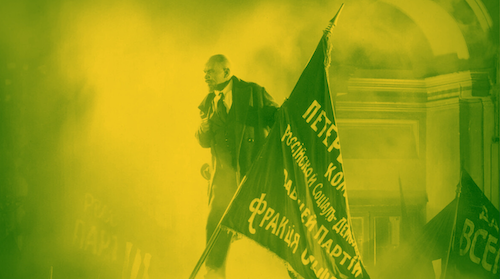
7. October: Ten Days That Shook the World
The first of the three films that Eisenstein worked on with Grigori Aleksandrov, October: Ten Days That Shook the World is as propagandistic as Eisenstein ever got. It is a clear depiction of Russia during 1917’s governmental shift (mainly the October revolution, hence the film’s name). Commissioned by the Russian government to honour the tenth anniversary of this event, both directors used this opportunity to flex their cinematic muscles. This film feels like a lesson in dynamic filmmaking all in the name of honouring a motherland; while the strong political affiliations are hard to shake off, the groundbreaking direction here by both Eisenstein and Aleksandrov are similarly hard to ignore.

6. The General Line
Yet another collaboration between Eisenstein and Grigori Aleksandrov, The General Line was simply meant to be a propagandist depiction of agriculture; the project was to honour Bolshevik Leon Trotsky. The project was paused so October: Ten Days That Shook the World could be completed, but, once resumed, much of The General Line had to be changed due to the drastic change in sociopolitical discourse; everyone had moved on from Trotsky. The effort to salvage the film in some sort of a way resulted in a narrative film about a young woman who hopes to survive; her quest is detailed by a nearly surreal set of shots that turn her farm into the ultimate dream of success in the face of adversity.

5. ¡Que viva México!
I don’t even know what to consider ¡Que viva México!. What was meant to be a documentary-like travelogue to encourage people to visit Mexico (requested by socialist author Upton Sinclair, known for Oil!, The Jungle, and many other novels) became an avant-garde exposition of incorporating the nation’s history, revolution, and culture into experimental vignettes. The project didn’t come to fruition and was abandoned due to production nightmares and censorship-related qualms. The film was resurrected by Eisenstein’s frequent collaborator, Grigori Aleksandrov, and editor Esfir Tobak. Their efforts render ¡Que viva México! a bit of a documentary artifact: a collection of shattered footage to recreate a film not as a coherent story or travelogue, but, rather, a fractured whole of a film that questioned what could have been (the film almost feels like a cinematic take on the Japanese art of kintsugi). Whatever ¡Que viva México! is, it’s an anthropological and political fever dream.

4. Strike
Eisenstein’s debut feature film was a clear sign that he was destined to make motion pictures (it is a distant leap in quality from the comedic short, Glumov’s Diary. The first Eisenstein film I ever saw (thank you, York University’s film classes), Strike is a natural foray into the Soviet director’s works. Not only is it as viciously political as anything he’s ever done, and the film is stuffed with many of the visual motifs that the filmmaker would be known for (thought provoking montages, intriguing overlaying images, dynamic angles and close-ups), Strike is a more digestible form of Eisenstein’s style (well, outside of the infamous shot of the cow being slaughtered, which would be referenced in Francis Ford Coppola’s Apocalypse Now). This story of a pre-revolution Russia features the titular uprising by disgruntled factory workers; as great as this film is, Strike walked so another similar film about a revolution could run.

3. Alexander Nevsky
Eisenstein’s career in the thirties suffered quite a bit, between the projects that would be banned or left unfinished and the fact that he was being pulled and neglected from all angles (especially when his politics were being scrutinized). However, it is clear that his war epic, Alexander Nevsky, was a clear comeback that was instantly one of the largest-scaled war films of its time (and a major influence on what cinematic action and a historical epic could be). This detailed look at Prince Alexander and his army’s defense against the Teutonic Knights is a massive and ambitious affair: Eisenstein did not have to go to Hollywood in order to evoke its expectations (he made damn sure to accomplish what he set out to do, really).

2. Ivan the Terrible
If Alexander Nevsky saw Eisenstein working on a larger scale, then Ivan the Terrible was a behemoth. The project was almost too big, with Eisenstein wanting to make this historical epic based on Ivan Vasilyevich a three-part film. Unfortunately, the third part never saw the light of day, and it’s a miracle that we were even acquainted with Part II at all (it was ultimately released in 1958, thirteen years after Part I, since it was banned). Even these two parts are quite something (I have considered them one film, since Eisenstein made these separate parts with the intention of them being one complete picture). In ways, Ivan the Terrible is Eisenstein’s best directed film and a massively difficult undertaking with what he accomplishes narratively, artistically, and thematically. It would have been a crying shame if we were forever barred from watching as much of this near-masterpiece as we are fortunate to see now.

1. Battleship Potemkin
People point to films like Orson Welles’ Citizen Kane as the major turning point in cinematic history when motion pictures were forever changed under the eye of a passionate auteur. However, before Citizen Kane, there were films like Eisenstein’s Battleship Potemkin (which, I would argue, even more films are indebted to). Similar to Strike, Battleship Potemkin is a propagandist view of the working class partaking in mutiny in order to overtake their oppressors. Here, the story is based on the real events of the titular Battleship Potemkin in 1905 and the many harrowing events that took place (from the authoritative rule on said ship and the mutiny that ensued, to shocking developments that extend even away from the Potemkin). The entire film is an expertly made silent film that renders it unquestionably one of the greats of the era; during a time where many directors were wondering about the future of the medium and what could be accomplished, artists like Eisenstein felt five moves ahead.
As I have stated, the entire film is masterful, but I couldn’t write a blurb about it here without discussing its most iconic sequence: the Odessa steps montage. The scene that single handedly changed how films could be edited and how sequences could be compiled, the moment those Cossacks slowly march down the steps of Odessa and mow down a sea of civilians with their bayonets is precisely when the cinematic medium learned what true fear and danger in film could look like, how to create effective relationships between different shots (like a call-and-response between images), and how audiences could be baited via such a devastating twist. This sequence has been referenced and parodied for over a century mainly because it is one of the most discussed sequences in film courses. Rightfully so: this sequence was not the invention of the wheel for cinema, but the discovery that the wheel could do more than just roll down a hill (it could become a means of transportation-related conveyance). Don’t let this shoutout confuse you: all of Battleship Potemkin is astonishing and a must-watch for any cinephile (especially those with interest in silent cinema).


Andreas Babiolakis has a Masters degree in Film and Photography Preservation and Collections Management from Toronto Metropolitan University, as well as a Bachelors degree in Cinema Studies from York University. His favourite times of year are the Criterion Collection flash sales and the annual Toronto International Film Festival.