
Un simple accident
Written by Dilan Fernando
Warning: The following review is of a film that is part of the 2025 Cannes Film Festival and may contain spoilers for Un simple accident. Reader discretion is advised.



Of all the films I was fortunate to watch at the 78th Cannes Film Festival, no other film’s greatness was apparent from the very first shot than Jafar Panahi’s latest film, the Palme D’or winning Un simple accident. Its greatness stems from the poignant restraint in the film’s writing, direction, cinematography, sound design and editing; from someone who has a deep understanding of feeling and emotion. The film opens with a family of three driving on a dark road; an expectant mother in the passenger seat, husband Eghbal (Ebrahim Azizi) piloting the car and their young daughter Nilufar playing in the backseat. Through the rear windshield driving in the opposite direction, another car’s tail lights glow red as a pack of dogs run behind it. Later on in the scene Eghbal accidentally runs over a dog that bolts in front of the car. He gets out to remove the remains of the animal wedged underneath. Eghbal is silent throughout the remainder of this scene, coming to the realization that even the car doesn’t provide the safety he requires. Nilufar, shaken by the experience, slinks in her seat, “You killed it.”, she says. Nilufar’s mother tries to console her, “It was just an accident. What will be will be. God surely put it on our path.” Nilufar responds, “God had nothing to do with it.” With this scene Panahi quickly establishes the film’s themes of life, death, morality, fate, chance, belief, empathy and humanity.
The car continues on its journey before breaking down to a stop in front of a garage that’s closed. One of the mechanics arrives and tells Eghbal he’ll fix it. As the car is being repaired, another mechanic who owns the garage Vahid (Vahid Mobasseri) speaks on the phone with his friend and mother about delivering a new van to his sister. The mother and Nilufar walk through the garage looking for the bathroom and turn on the wrong switch startling Vahid, “Who turned on the lights?” he asks. (An allusion to the theme of chance or fate.) Eghbal calls for Vahid, his voice echoes through the garage like it has been through Vahid’s head. Vahid’s stunned by the voice, its eerie menacing tone amplifies the words, “Hello Vahid. Hello Vahid? Hello, Vahid?” Vahid watches the doorway from the top of the stairs, a distinct repetitive sound reawakens his dormant paranoia. The sound design is another character in this film that rings through the mind of all those Iranians affected by the overruling regime.
Vahid’s paranoia begins to feed his irrationality. He follows the family back to their house (in the van for his sister) and waits until Eghbal leaves, hoping to get some confirmation. Vahid tails Eghbal for a while hoping for an opportune time to enact revenge but gets cold feet. Vahid drives away accepting it wasn’t meant to be until he sees Eghbal again… Disillusioned, Vahid goes to talk with Salim, an elderly friend of his who owns a bookstore. Vahid tells Salim he’s seen who he believes is ‘Peg-Leg’ (Eghbal) a sadistic army officer who was an overseer at a prison for political prisoners where Vahid and Salim were for five years. Salim who isn’t as spry as he once was and whose penchant for revenge doesn’t equal that of Vahid’s, tries to talk him out of it saying, “There’s no need to dig their graves, they've already done it themselves. Don’t let him bury your ideals as well.” Unwilling to listen to reason, Salim sends Vahid to a friend of his, Shiva (Mariam Afshari), a wedding photographer who was also under Eghbal’s thumb.
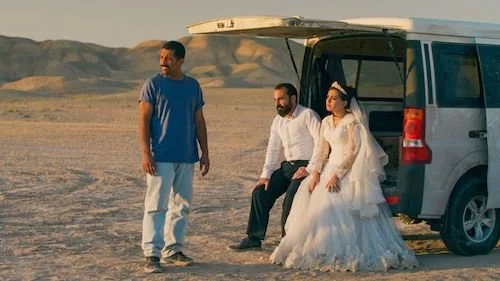
Shiva photographs a couple, bride Golrokh-Goli (Hadis Pakbaten) and groom Ali (Majid Panahi) before being drawn away by Vahid to discuss whether it could be Eghbal or not. Once the couple hears word of ‘Peg-Leg’, Goli, refuses to partake in anything to do with the nuptials until she enacts her revenge. Shiva tells her ex-lover Hamid (Mohamad Ali Elyasmehr) who arrives swiftly upon hearing ‘Peg-Leg’ and the revenge plan. Ali, who wasn’t in the prison alongside the others, is on the outside looking in, hoping to sway fiancée Goli. The five members of this amalgamated revenge squad lash out and leer at one another, wrestling with each of their own plans of vengeance. Ultimately, they must come to an agreement on whether – blindfolding, flogging, lynching, humiliating, psychological breakdown, murder or spiritual impurity; is the right fit for levelling out ‘Peg-Leg’.
Panahi and his characters never let revenge consume them, it’s the driving force that sets them on their journey but life helps them realize that it’s not worthwhile. For each of these dramatic pot boiling scenes Panahi includes scenes of natural comedy to create some levity. His sense of humour is quite complex, and the film can be read as a dark political satire starring a bunch of screwballs. The scene in the carpark with the two security guards is an example of this political humour at its finest. Notice the way Shiva dons the headscarf when greeting them. During the Cannes press conference for the film when asked about how the experience changed his filmmaking, Panahi replies, “After getting out of prison I noticed that the world has changed. The reason for women choosing whether or not to wear head scarves are their choice.”
Ask yourselves, is Panahi’s sense for poetic realism what makes great characters that stem from real people or shows how real people make great characters? At one point in his life surely Panahi felt like Vahid, Shiva, Goli, Hamid and later on like Salim but not all of his films as some people believe are autobiographical. Yes, the films all have personal elements to them but overall are part of a collective experience. Why I prefer this film over many of Panahi’s other outstanding films is because it’s more reflective of a group rather than an individual of it. Panahi says, “Everything you see in the film is not from my own experience, it’s a reflection of the Iranian people. The Iranian government is locking up its own citizens.”
Most of Panahi’s other films have himself as the central character which is understandable, given the tumultuous efforts to make them in spite of the conditions set by the Iranian government. Panahi’s interweaving of different genres and elements – drama, family drama, political, satire, comedy, thriller and revenge all make for a thought-provoking and entertaining film. Regardless of how Panahi and the characters feel inside with the flame for revenge flickering away until the livewire burns down, they are all shrouded in humanity. It’s this humanity that leads the characters toward the closure they believe will be attained through vengeance. By the end of the film, is the echoing of this penchant for vengeance a reminder for the characters of their humanity as a strength or weakness?

Dilan Fernando graduated with a degree in Communications from Brock University. ”Written sentiments are more poetic than spoken word. Film will always preserve more than digital could ever. Only after a great film experience can one begin to see all that life has to offer.“